

The nose is one of the most visible features of the face and plays a fundamental role in facial harmony. When considering the different types of noses, the aquiline nose deserves special attention. Broadly speaking, it is a nose with greater volume—especially along the nasal dorsum—which can lead, among other aesthetic consequences, to an imbalance in facial proportions.
In this post, we help you identify an aquiline nose and share the most effective treatments to correct it and achieve greater facial harmony.
What is an aquiline nose like?
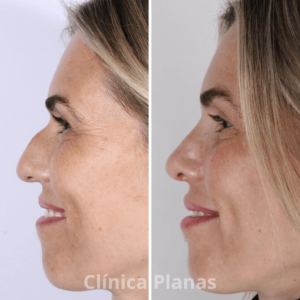
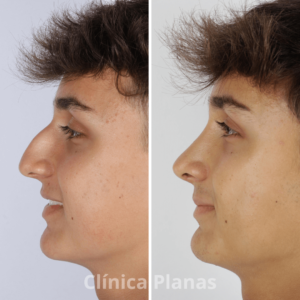
The aquiline nose is a very common type of nose, typical of Mediterranean countries. It is characterized by:
- A convex curve of the nasal dorsum
- A very prominent dorsum
- It is often combined with a drooping nasal tip
The natural consequence of this nasal type on facial proportions is that it occupies more visual space on the face, affecting overall harmony. One example is the effect of the eyes appearing smaller than they actually are. In fact, one of the most common reactions among patients who reduce the size of their nose is that their eyes appear larger afterward—simply because, proportionally, they occupy more space on the face.
Causes of an aquiline nose
Genetics
The vast majority of aquiline nose cases have a genetic origin. It is uncommon to find other factors responsible for this nasal type. In most cases, the cause is an excessive development of the nasal bones and cartilage structures.
Trauma
That said, a significant nasal trauma can also lead to internal fibrosis that increases the volume of the nasal dorsum. This may occur both during the growth phase and in adults whose nasal structure is already fully developed.

How to correct an aquiline nose
The appropriate technique to correct an aquiline nose is reduction rhinoplasty. Broadly speaking, the procedure involves filing down the dorsal hump and narrowing the nasal bridge. The nasal tip is also addressed, depending on the specific needs of each case, using either an open or closed rhinoplasty approach.
Ultrasonic rhinoplasty
Whenever the case allows, Clínica Planas uses the most innovative surgical technique for correcting nasal deformities: ultrasonic rhinoplasty.
The distinguishing feature of ultrasonic rhinoplasty is the use of ultrasound technology to file and reshape the nasal bones. This results in:
- Greater precision
- Less bleeding and reduced bruising
- A much lighter postoperative recovery
This procedure can be performed under general anesthesia or local anesthesia with sedation, and patients are able to return home the same day of surgery.
Rhinoplasty
There are certain cases in which ultrasonic rhinoplasty is not the optimal procedure—for example, when the nasal bones are extremely hard and cannot be properly reshaped using ultrasound. In such situations, the traditional rhinoplasty technique is applied.
Septorhinoplasty
In some cases, the patient needs not only an aesthetic improvement of the nose but also better respiratory function. In these situations, a septorhinoplasty can be performed.
This technique combines rhinoplasty or ultrasonic rhinoplasty with septoplasty, allowing both aesthetic and functional corrections to be carried out during the same surgical procedure.
Rhinomodeling
Rhinomodeling with hyaluronic acid allows for the improvement of the curve of an aquiline nose without the need for surgery. However, it is important to note that the result will always be a larger nose.
In other words, the appearance of the nose can be improved by injecting dermal filler into the nasofrontal angle and the nasal tip to transform a curved dorsum into a straight one, but this is achieved by increasing the overall volume of the nose.
Other treatments
As with any nasal type, the key is to analyze facial proportions to achieve maximum harmony. There are complementary treatments to rhinoplasty that can help enhance facial balance, such as adding volume to the cheekbones, chin, or lips.
Ways to disguise an aquiline nose
Disguising it with makeup
Makeup is a great tool for highlighting or softening different facial features, mainly through the use of appropriate colors and textures. In the case of large or aquiline noses, makeup artist Sonia Marina recommends “adding darker tones to the tip and bridge of the nose using bronzing powder or a foundation slightly darker than your natural skin tone.”
Haircuts for an aquiline nose
Haircuts and hairstyles can also work for or against us when it comes to minimizing the prominence of an aquiline nose. In particular, it is advisable to avoid very short haircuts, medium-length styles, and extremely straight hair.
On the other hand, long hair and hairstyles with volume help draw attention away from the nose by giving more visual prominence to the hair, helping to balance facial proportions.
TRATAMIENTOS RECOMENDADOS

Rhinoplasty
Rhinoplasty is a surgical procedure designed to correct nasal deformities in order to improve facial balance and harmony.

Septoplasty
Septoplasty aims to correct deformities of the nasal septum that cause breathing difficulties.

Nasal Septum Reconstruction
Nasal septum reconstruction surgery improves breathing by correcting septal deviations and perforations.
ARTÍCULOS RELACIONADOS
-

Choosing to undergo rhinoplasty is a deeply personal decision. At Clínica Planas, one of the…
-

Every face is unique, just as every person is unique. The different facial features play…
-

Did you know that there are different types of noses depending on geographic region and…