What is Lymphedema?
Lymphedema is nothing more than an alteration of the lymphatic system that results in an accumulation of lymph, a bodily fluid, accumulating in the limbs, and is some occasions in other areas of the body – but primarily in the lower and upper extremities. –
It is important to note that the leading cause of lymphedema in the developed world is oncological surgery, with breast cancer being the most frequent amongst them. Due to that, one third of women with breast cancer will develop lymphedema in the upper limbs.
There are also cases that derive from prostate cancer treatment in men, as well as from gynecological cancers –ovarian, endometrial– in women, and also melanoma. Therefore, there are several surgeries in which those lymph nodes are manipulated, increasing the risk of developing lymphedema.
Book an
appointment
CLÍNICA PLANAS' DATA PROTECTION INFORMATION CLICK HERE
Purposes: To respond to your requests and to send you commercial information about our products and services, including via electronic means. Rights: At any time, you can withdraw your consent, access, rectify, delete your data and exercise other rights at doctor@clinicaplanas.com. Additional Information: Privacy Policy.


Our Patients’
Reviews
 Bahija Sehetal
05/08/2026
Bahija Sehetal
05/08/2026

 Ruben Palazon
16/01/2025
Ruben Palazon
16/01/2025
 Raquel Pacheco
12/08/2026
Raquel Pacheco
12/08/2026
 Robbie Berman
11/08/2026
Robbie Berman
11/08/2026
Causes for the emergence of lymphedema
Something must be highlighted: lymphedema will indeed cause an increase in volume // swelling due to that increase in fluid, but it will also result in an immune system deficiency.
When we cut those nodes, such as when we perform a dissection because of a risk of cancer cell migration, what we are doing is eliminating that part of the immune system of that anatomical area.
Therefore, patients, like women that suffer from breast cancer, are at higher risk of infections in their affected arms or in their legs when the lymphedema is secondary to gynecological cancers or prostate cancer in the case of male patients.
Previous surgeries
In the developed world, lymphedema is very frequent in the oncological surgeries where the lymph nodes are touched.
Radiation treatments
Patients who have undergone both surgery as well as radiotherapy have an increased risk of developing lymphedema. Also, in prostate cancer treatment cases where no surgery has been performed and only targeted radiotherapy has been used. Unfortunately, that targeted radiotherapy can also cause lymphedema.
Parasites
The issue of parasites is more common in the developing world, in areas such as the Amazon rainforest or India. Patients that plan on going on exotic trips, especially during the summer, must take this into consideration if after wandering through the jungles of Bangladesh suffer swelling in their limbs or in their rectal area. Unfortunately, they have been bitten by a mosquito carrying a parasite called filaria. These parasites nest inside the lymphatic system, obstructing it.

What is primary lymphedema?
Primary lymphedema also exists, which are patients who are born with an underdeveloped nonexistent development of the lymphatic system. It is much less common but one must keep it in mind, as there are patients who do not know why their legs or ankles swell up, and spend years thinking they are sprains or strains. In many of these cases, when the patients reach our clinic, it is too late. Primary lymphedema exists, and is largely unknown to 80% not only of the general population but also doctors and professionals working within the healthcare system.
What are the main symptoms of lymphedema?
What causes lymphedema is a significant swelling that can reach incredible dimensions. That volume can be translated into:
1. Muscle atrophy
2. Difficulty in lifting the limbs
3. And finally, when lymphangitis –infections of the lymphatic system– or erysipelas
–infections of the superficial lymphatic system affecting the skin– has already
suffered, patients experience an absolute loss of flexibility.
Does the same happen with lipedema?
With lipedema there is no risk of having infections, as the patient has a competent immune system. However, they do suffer from that increasing in volume and the consequent loss of function.
Postoperative phase
Unlike the postoperative process for lipedema, which is much quicker and standardised, the postoperative process for lymphedema will depend on the surgical technique that has been used and the extent of the lymphatic system's repair. In any case, it requires a clearer and more controlled postoperative care, as the patients must make an important change in their lifestyle during more than a year.
It is a journey we all take together, the patients and the therapeutic team, where surgeons, nurses and physiotherapists, amongst others, will participate. The objective is to educate the patient and help them understand the level of function we have restored to that lymphatic system, how they have to adapt their life, and how they need to support the surgery and those changes that have been made to their lymphatic system to ensure they remain efficient. That requires a joint effort and some follow-up visits. It is a therapeutic journey that we all take together, hand in hand, during 18 months, until a stable result is reached and the patient has learned to manage on their own.
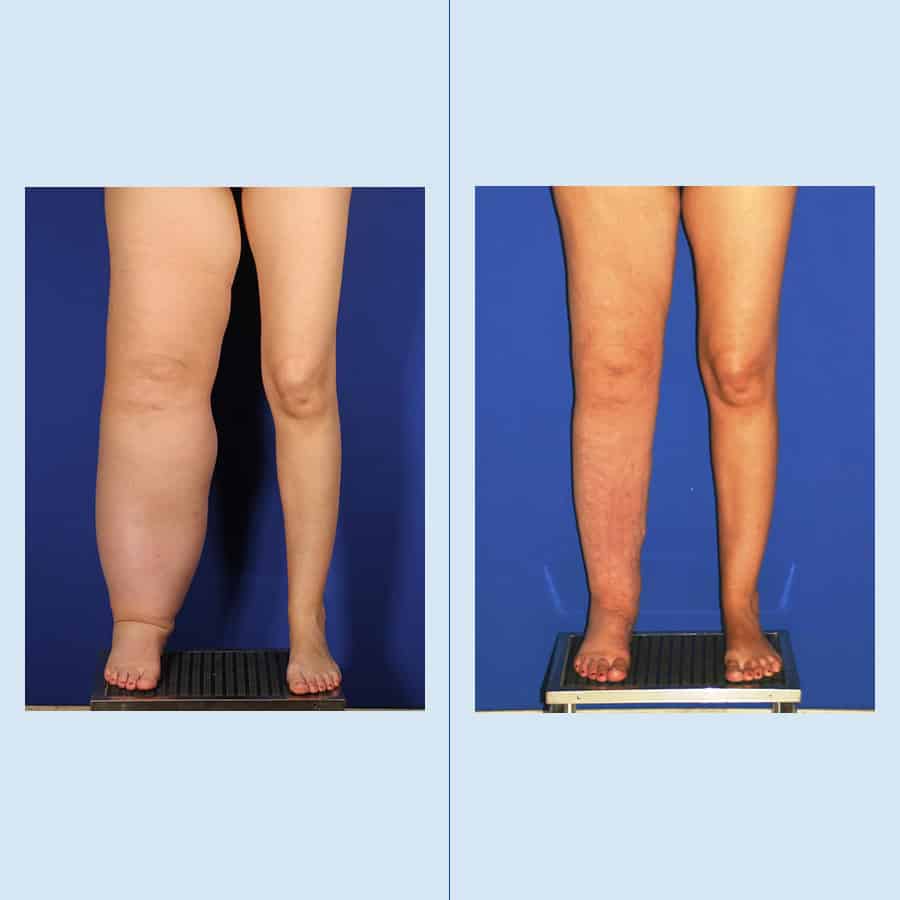
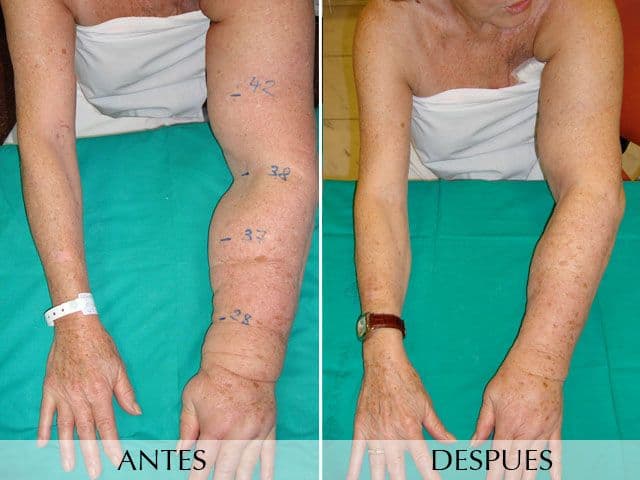
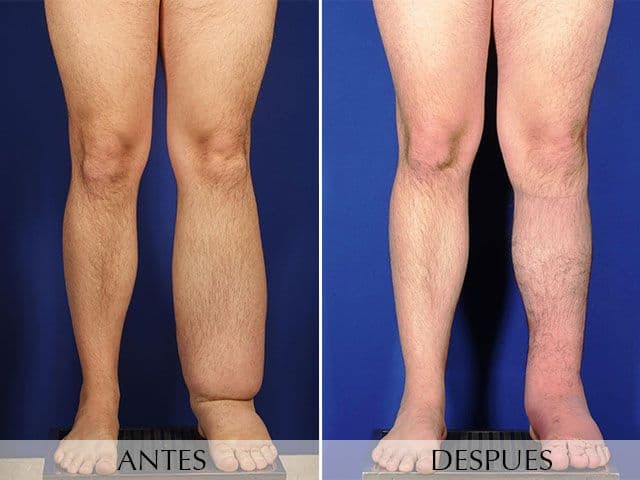
Lymphedema surgery Before and after
F.A.Q.
-
How to cure lymphedema in the legs?
Lymphedema, both in the legs and arms, is difficult to cure. The world cure means that we leave things as how they were before, and that is only possible in two cases.
The first is performing a prophylactic surgery; that is, at the moment we remove the lymph nodes, destroying the lymphatic system, we repair it. Then, it is cured, as that which we have altered, we have repaired. The second case is when the patient comes shortly after their surgery. People who have undergone lymph node removal and within a few months seek treatment.
Once lymphedema is established, we can repair and better than lymphedema by 60% or 70%, up to 80% in some cases. But achieving a full 100% is very difficult. -
How long does lymphedema last?
If left untreated, lymphedema will last forever. When viewed overtime it always worsens; and will end up being a chronic problem, which becomes progressively disabling and has poor prognosis
-
Which specialist treats lymphedema?
Many years ago it was vascular surgeons who treated it, but they practically abandoned efforts to try to improve the techniques. Meanwhile, plastic surgeons, with their microsurgery, entered the field.
We can say that currently and worldwide, lymphedema is treated by plastic surgeons specialized in lymphatic microsurgery. The non-surgical aspect is carried out by rehabilitation physicians/doctors and specialists in physical medicine. -
Can it be prevented?
Lymphedema can be treated. Its prevention consists in performing a less aggressive surgery that removes lymphatic tissue and, intraoperatively, assessing the lymphatic system to repair it immediately if needed. It is important to note that at Clínica Planas we perform prophylactic surgery for lymphedema in breast cancer patients, and have gone from a 30% rate of post-breast cancer lymphedema to less than 3%.
Therefore, we can say that yes, we can prevent lymphedema -
What does having the Mitaka microscope entail?
To treat lymphedema it requires more than simply being a plastic surgeon or knowing how to perform microsurgery. You need to have very advanced technological equipment, that consists of indocyanine green technology, the indocyanine scanner, a 3-Tesla lymphatic MRI, and a team of radiologists that are skilled in using it –of which there are very few–. A proper magnification and super microsurgery materials are also essential.Nowadays, at Clinica Planas, we are equipped with the Mitaka 500, the most powerful optical microscope in the world, which allows us to magnify and visualize the structures to be able to repair them. With the traditional microscopes found in 99% of hospitals in Europe, we can effectively achieve lymphatic work in 20% of the cases. Maximum technology is needed in order to properly work with the lymphatic system.
Related treatments
-

Lipedema Surgery
At Clínica Planas, lipedema is diagnosed and treated by specialists in plastic surgery and experts in lymphatic system disorders. -

Advanced Physiotherapy of Lymphedema
New system of advanced physiotherapy to treat lymphedema from a non-surgical and conservative point of view -

Limpehedema Early Detection Program
Early detection, guarantee of effective lymphedema treatment
Related
articles
-

5 claves sobre el diagnóstico y tratamiento del linfedema
El diagnóstico y tratamiento del linfedema es una lucha diaria que vivimos en Clínica Planas. Organizamos un directo con el Dr. Jaume Masià. -

Clínica Planas: Center of Excellence
En Clínica Planas hemos recibido el sello americano Center of Excellence de Lymphatic Education & Research Network. -

Live Instagram: Cáncer de mama, antes y después
Con motivo del Día Mundial Contra el Cáncer de Mama, organizamos un nuevo directo de Instagram el martes 10 de octubre