
The abdominal skin laxity is a common concern among both women and men and can occur even in people who maintain a healthy weight and follow a healthy lifestyle.
- Significant, frequent or rapid changes in weight
- hormonal changes
- and pregnancy can affect the ability of the abdominal skin to adapt to changes in volume.
When the tissues have undergone significant stretching, the skin may lose some of its ability to retract, resulting in excess skin that cannot always be corrected through diet and exercise alone.
Furthermore, not all abdomens with a bulging or poorly defined appearance have the same underlying cause:
- in some patients, the main problem is localised fat
- in others, skin laxity
- and in certain cases, there is a separation of the rectus abdominis muscles.
Correctly identifying which of these components is present is essential to determining the most appropriate treatment.

Why does abdominal skin laxity occur?
Abdominal skin laxity can occur for a variety of reasons. The most common include:
- significant or repeated changes in weight
- hormonal changes
- and pregnancy.
When the abdomen increases in volume, the skin needs to stretch to adapt. If there is subsequently a significant reduction in volume, the skin is not always able to retract completely.
This can happen particularly when weight loss occurs very quickly.
In recent years, this phenomenon has also been observed in patients who experience significant or rapid weight loss associated with the use of GLP-1 receptor agonists.
When weight loss occurs very quickly, the skin may not have enough time to gradually adapt to the body’s new volume. The collagen fibres may weaken and, as a result, skin laxity may develop that, in certain cases, cannot be corrected solely through technologies designed to promote skin retraction.
When there is a significant amount of excess skin, surgical procedures to remove the surplus tissue may need to be considered.
What factors can worsen abdominal skin laxity?
The development and progression of skin laxity do not depend on a single factor. Genetics, skin quality, weight changes, diet (protein intake), physical activity and pregnancy can influence the ability of the tissues to remain firm.
Genetics and skin quality
Genetics partly determine the characteristics and quality of our skin.
Not everyone has the same dermal thickness or the same ability to retract over the years. For this reason, when faced with similar changes in weight or body volume, the skin’s response may differ from one person to another.
The quality of the dermis therefore influences the tendency to develop abdominal skin laxity.
Frequent changes in weight
Repeated cycles of weight gain and weight loss subject the skin to successive periods of stretching and retraction.
When these changes occur frequently, the tissues’ ability to adapt may be compromised, promoting the development of skin laxity.
Pregnancy
Pregnancy is another factor that can significantly alter the anatomy of the abdomen.
During pregnancy, both the skin and the abdominal muscles undergo considerable stretching to accommodate the increase in volume.
After childbirth, the tissues do not always fully return to their previous state, meaning that skin laxity may persist and, in certain cases, there may be a separation of the rectus abdominis muscles.
Lack of physical activity
Physical activity also influences the appearance of the abdomen.
When we exercise and the muscles contract, they place tension on the fibroseptal tissue, which can help improve tone and enable the skin to adapt better to the underlying muscle.
Can exercise improve abdominal skin laxity?
Yes, exercise can help improve the appearance of abdominal skin laxity to a certain extent.
When the muscles are exercised, their contraction places tension on the fibroseptal tissue and may help the skin adapt better to the muscle, visually improving the tone of the abdomen.
However, exercise does not affect all the components that can alter the abdominal contour in the same way.
When there is a significant amount of excess skin, exercise has a limited ability to correct it. For this reason, before determining which treatment may be appropriate, it is necessary to identify whether the main problem lies in the fat, skin or muscles.
How can you tell whether the abdominal problem is fat, skin or muscle?
This is one of the most important questions when assessing the abdominal contour.
A poorly defined abdomen can have different causes and, in some patients, several of them may coexist.
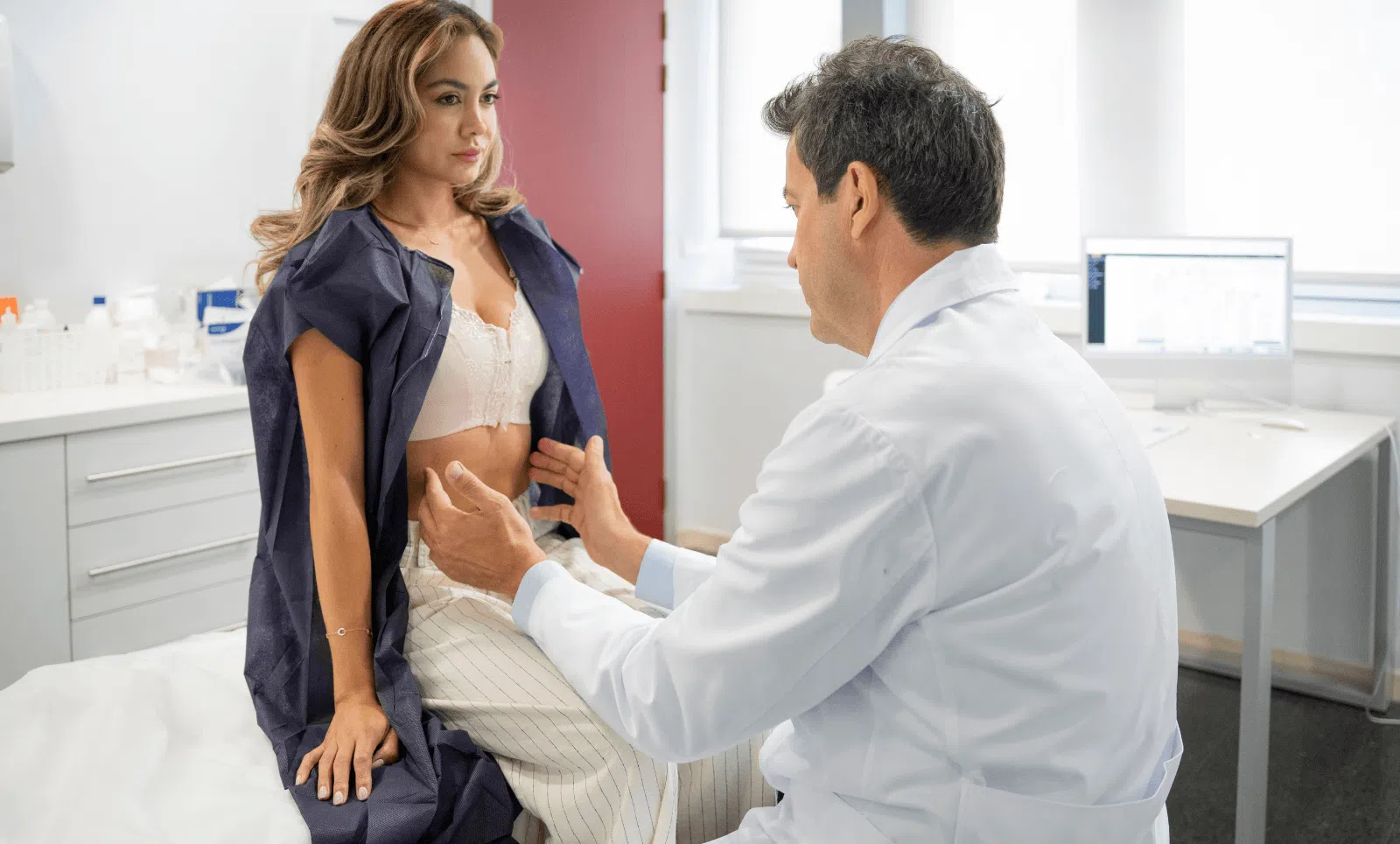
An assessment by a plastic surgeon makes it possible to determine which structures are actually causing the appearance of the abdomen.
When the problem is localised fat
If someone is at a healthy weight but continues to have certain fat deposits that alter the shape of their body, there may be a localised fat component.
In these cases, the problem is not necessarily related to being overweight, but rather to the distribution of body fat.
When the problem is skin laxity
When the skin moves excessively when changing position or when, while sitting and relaxed, excess skin alters the appearance of the abdomen, there may be a significant skin laxity component.
The skin has lost some of its ability to adapt and retract and, depending on the amount of surplus tissue, different treatments may need to be considered.
When the problem is the abdominal muscles
In other patients, the abdomen continues to have a bulging appearance even if they exercise a great deal.
In these cases, there may be a separation of the rectus abdominis muscles.
Therefore, doing more exercise will not always resolve the problem if the bulging is caused by the separation of the abdominal muscles.
When is an abdominoplasty recommended?
When there is excess abdominal skin that cannot be corrected through other procedures, surgery to remove the surplus tissue may need to be considered.
However, there is no single type of abdominoplasty.
The technique must be adapted to the location and amount of skin laxity in each patient. Different procedures may be considered depending on whether the excess skin is located below the navel, above it or affects the entire circumference of the body.
Mini-abdominoplasty
A mini-abdominoplasty may be recommended when skin laxity is limited to the infraumbilical area, in other words, below the navel.
This procedure specifically treats excess skin located in the lower abdomen.
Hybrid abdominoplasty
When supraumbilical skin laxity is also present but measures approximately 3 centimetres or less, a hybrid abdominoplasty may be considered.
This approach combines a mini-abdominoplasty with Renuvion on the upper abdomen to promote skin retraction.
Full abdominoplasty
When supraumbilical skin laxity measures approximately 3 centimetres or more, a full abdominoplasty may be necessary.
In these cases, the excess skin requires a more extensive approach to adequately treat the abdominal laxity.
Circumferential abdominoplasty
When the skin laxity is not limited to the abdomen and affects the entire circumference of the body, a circumferential abdominoplasty may be recommended.
This procedure addresses a more extensive amount of excess skin around the body contour.
Reverse mini-abdominoplasty
There is another option for patients whose skin laxity is located exclusively above the navel.
When supraumbilical skin laxity measures up to approximately 4 centimetres, a reverse mini-abdominoplasty may be performed.
This technique does not cross the midline and can make use of existing scars from a previous mastopexy.
Reverse abdominoplasty
When there is a greater amount of supraumbilical skin laxity but no infraumbilical laxity, a full reverse abdominoplasty may be considered.
The choice between one technique and another will therefore depend on the precise location and extent of the excess skin.
What treatment do I need for abdominal skin laxity?
Not everyone with abdominal skin laxity needs an abdominoplasty.
Treatment depends primarily on what is causing the appearance of the abdomen and on the amount and location of the excess skin.
If the main problem is localised fat, the approach will differ from that used for a patient with a significant amount of excess skin. Likewise, when there is a separation of the rectus abdominis muscles, the muscular component must also be taken into account.
For this reason, the first step is to obtain an accurate diagnosis that distinguishes between:
- Localised fat.
- Skin laxity or excess skin.
- Separation of the rectus abdominis muscles.
- A combination of several of these factors.
Based on this assessment, the most appropriate treatment for each patient’s anatomy can be determined.
What results can be expected from surgery for abdominal skin laxity?
The results depend on the correct indication for surgery, the patient’s characteristics and the technique used.
Appropriate patient selection is essential. The best candidates are those for whom surgery is correctly indicated, who maintain healthy habits based on diet and exercise and who have realistic expectations regarding the results that surgery can provide.
It is equally important that the procedure is performed by a specialised team using the techniques and technologies most appropriate for each case.
The aim is not only to remove excess skin, but to achieve a harmonious improvement in the abdominal contour that is adapted to each patient’s anatomy.
So, when should I consider an abdominoplasty?
An abdominoplasty may be considered when there is excess abdominal skin that is unable to retract adequately and cannot be corrected through exercise alone or technologies designed to improve skin retraction.
The amount and, above all, the location of the skin laxity will determine which technique may be recommended: from a mini-abdominoplasty for laxity located below the navel to a full, reverse or circumferential abdominoplasty in more extensive cases.
For this reason, before deciding which procedure to undergo, it is essential to determine whether the appearance of the abdomen is primarily caused by localised fat, excess skin, muscle separation or a combination of these factors.
An individual assessment by a plastic surgeon will make it possible to establish this diagnosis and determine which treatment may provide an appropriate result for each patient.
RECOMMENDED TREATMENTS
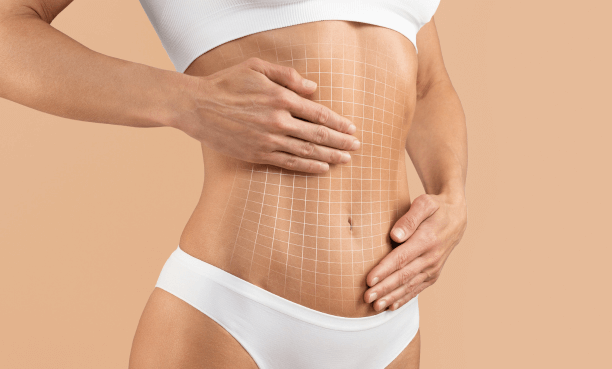
Abdominoplasty
Abdominoplasty allows for the restoration of a flat abdomen by eliminating sagging and fat deposits through the repair of the abdominal muscle wall.
Body Lipostructure
Lipo-structuring is the technique that allows us to restore and add volume to, or reshape, various areas of the body using the patient’s own fat.

Express Body Contouring
Eliminates fat deposits in the arms, flanks, and inner thighs. No general anesthesia, no hospitalization, and rapid recovery.
