

The term “GLP-1 face” has become popular to describe certain changes that may appear in the face after significant and rapid weight loss.
Loss of facial volume, hollower cheeks, increased skin laxity, more visible wrinkles, or a tired appearance are some of the changes that can make the face look older or more gaunt.
However, it is important to clarify one fundamental point: so-called GLP-1 face is not caused directly by the medication itself, but is mainly associated with the loss of body fat — including facial fat — that can accompany rapid weight loss without compensating for the protein intake that is essential for healthy weight loss.
For this reason, treating GLP-1 face should not simply consist of “filling” the face. Before considering any procedure, a comprehensive assessment is necessary: how much volume has been lost, the degree of skin laxity, and the condition and quality of the skin.
Based on this diagnosis, different treatments can be combined to address firmness, structure, volume, and skin quality in a personalised way, always seeking to preserve the proportions and natural appearance of the face.

What exactly is GLP-1 face?
GLP-1 face is a popular term used to describe the older, more gaunt, or sagging appearance that the face can develop after significant and rapid weight loss.
Some of the most common changes include:
- Loss of facial volume.
- Hollower cheeks.
- A tired appearance.
- Increased facial laxity or sagging.
- More visible wrinkles.
- Loss of jawline definition.
- Increased laxity in the area under the chin.
The intensity of these changes is not the same for everyone. Factors such as the speed of weight loss, the total amount of weight lost, and age can influence how the face responds to weight loss.

Why does GLP-1 face occur?
Although the name of a specific medication is commonly used to describe it, to understand this phenomenon we need to look at what happens to facial tissues during a process of rapid weight loss.
When we lose weight, body fat decreases, and this reduction can also affect facial fat, which contributes to the volume and support of certain facial structures.
If volume is lost rapidly, the skin may not retract at the same rate. As a result, some areas of the face may appear more hollow, increased laxity may develop, and facial contours may lose some of their definition.
Therefore, rather than understanding GLP-1 face as a specific effect of a particular medication, it should be considered a variable combination of loss of facial volume and skin laxity associated with significant weight loss and protein adjustments that are neither personalised nor supervised by a specialised team.
How does the face change after rapid weight loss?
Changes can vary considerably from one person to another. However, there are certain areas where volume loss and laxity tend to become particularly noticeable.
Loss of volume and hollower cheeks
One of the most characteristic changes is loss of facial volume.
The cheeks may appear more hollow, and the face may lose some of the structure and proportions it had before weight loss.
When weight loss is significant, this reduction in volume can make the face appear much thinner and, in some cases, even skeletal.
More visible wrinkles and changes in skin quality
Reduced tissue support can also make certain wrinkles and expression lines appear more pronounced.
In addition, the skin may appear more dehydrated and less vibrant, meaning that the change affects not only facial volume or contours but also the perceived quality of the skin.
Loss of jawline definition
When facial volume decreases and laxity develops, excess skin can become particularly noticeable around the jawline.
As a result, the facial contour may lose some of its definition.
Laxity under the chin and in the neck
The lower part of the face can also be affected.
Volume loss, together with a reduced ability of the tissues to retract, can contribute to excess skin or laxity in the area under the chin, altering the transition between the face and neck.
Does GLP-1 face affect everyone who takes GLP-1 medications?
No. Not everyone who uses GLP-1 treatments develops these facial changes.
There are several particularly relevant factors:
- The speed of weight loss.
- The total amount of weight lost.
- The patient’s age.
- A non-personalised approach that is not supervised by a team trained to work with these molecules.
Therefore, facial changes do not depend solely on the treatment used, but also on how the weight-loss process develops and the characteristics of each person’s tissues.
Can GLP-1 face be prevented during weight loss?
Whenever possible, and always as part of the appropriate medical follow-up, avoiding excessively rapid weight loss may be an important consideration.
More gradual weight loss gives the tissues more time to adapt to changes in volume.
In addition, for certain patients, treatments aimed at improving skin quality and firmness may be considered preventively during the weight-loss process itself.
Gradual weight loss and medical supervision
Any adjustment to pharmacological treatment must always be carried out by the medical professional responsible for the patient’s care.
Many of the changes associated with so-called GLP-1 face do not depend solely on the medication, but on how the weight-loss process is managed. When weight loss occurs without professional supervision or monitoring, muscle mass is often lost along with fat, which can accentuate both a tired facial appearance and an overall sense of physical deterioration. This is why it is essential to have a specialised team that, on the one hand, adjusts the medication on an individual basis — assessing whether the dose needs to be increased and adapting the treatment to each patient’s characteristics — and, on the other, always combines it with a nutritional approach.
This nutritional follow-up makes it possible to calculate each person’s energy requirements and, in particular, their protein needs on an individual basis, as meeting daily protein requirements is not always straightforward. Preserving muscle mass during weight loss not only changes how these types of treatments are perceived, but also leads to different clinical outcomes: healthier patients and weight loss — whether in the context of overweight, obesity, or metabolic disease — achieved in a balanced and sustainable way.
As part of this follow-up, controlling the rate of weight loss may be relevant to promote a more gradual adaptation of the tissues and monitor how the face responds as body volume changes. This includes monitoring aspects such as:
- Fluid intake
- Protein intake
- Strength training
Preventive treatments for skin firmness
It is not always necessary to wait until volume loss or laxity becomes very noticeable before assessing the condition of the face.
In selected patients, treatments aimed at improving tissue firmness may be considered during the weight-loss process itself. One of the options is HIFU, which may be used preventively when appropriately indicated.
How can facial firmness be restored after weight loss?
Treatment will depend primarily on which component is most prominent in each patient.
A face that has mainly lost volume is not the same as one with a significant degree of laxity. Likewise, a patient with primarily structural changes should not be approached in the same way as one whose skin quality has also deteriorated.
For this reason, the approach may combine techniques aimed at:
- Promoting tissue contraction and tightening.
- Strategically restoring lost volume.
- Improving skin quality, vitality, and hydration.
The sequence of treatments is also important. In certain patients, it may be advisable to address laxity first and then assess how much volume actually needs to be restored.
Facelift when laxity is more structural
When weight loss has resulted in more pronounced laxity or a more structural loss of facial support, a facelift may be considered as a surgical option. Unlike less invasive treatments, this technique works by repositioning the SMAS (superficial musculoaponeurotic system), skin, and fat, removing excess tissue and acting directly on the deeper structures that support the face. This makes it possible to address more comprehensively the changes that tend to be concentrated in the lower third of the face, such as loss of jawline definition or laxity in the neck area.
A facelift may be particularly appropriate when the structural component is more prominent than simple volume loss, as it offers longer-lasting results in the medium and long term. In patients with more moderate laxity or where it is combined with other factors, less invasive treatments such as Morpheus8 or FaceTite may be considered as complementary options or alternatives, depending on the specialist’s individual assessment.
Morpheus8 to address facial laxity
When laxity is present, one of the first options that may be considered is Morpheus8.
The aim is to work on the tissues to promote contraction and tightening before deciding how much volume actually needs to be restored.
This approach avoids basing the entire strategy solely on adding volume with fillers. Once tissue firmness has been addressed, the face can be reassessed to determine whether volume restoration is actually necessary.
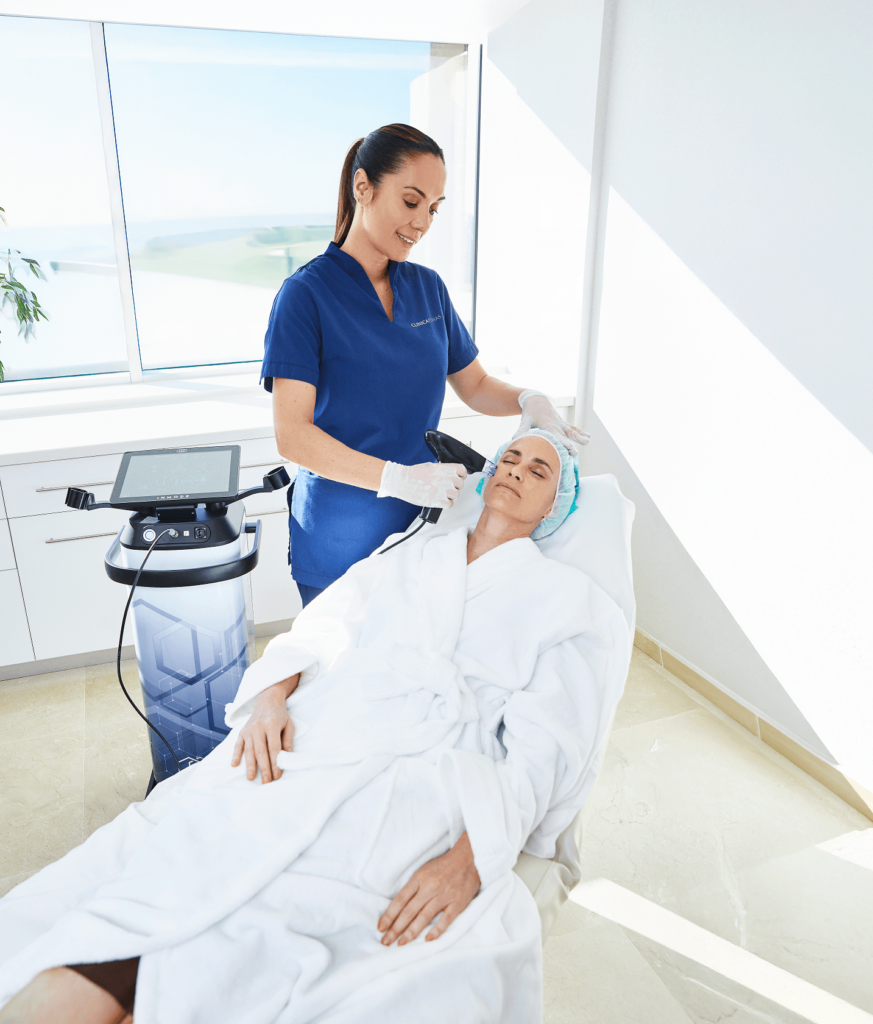
FaceTite when laxity is more pronounced
When the degree of laxity is more significant, FaceTite may be considered.
It is a minimally invasive technique that can form part of the treatment approach when more intensive action on tissue laxity is required.
The choice between Morpheus8, FaceTite, or other alternatives will always depend on the individual assessment, facial anatomy, and degree of sagging present in each patient.
Liquid facelift to restore lost volume
When significant loss of structure or volume is present in addition to laxity, a liquid facelift may be considered.
This approach can combine collagen stimulators and hyaluronic acid, personalising the treatment to restore volume specifically where it has been lost.
The aim is not to indiscriminately increase facial volume or attempt to “fill” every change caused by weight loss. Instead, the goal is to strategically restore lost volume while respecting each patient’s proportions, anatomy, and natural features.
Zaffiro to improve skin retraction and appearance
Another technology that may form part of the treatment is Zaffiro, which is based on infrared light.
Its aim is to generate a thermal lifting effect and promote skin retraction. One of its characteristics is that patients can return to their usual activities after treatment.
Depending on the proposed protocol, one session may be performed approximately every four or five months.
In addition, Zaffiro can be combined with a liquid facelift. When both treatments are combined, the proposed approach is to perform the liquid facelift first, followed by Zaffiro.
Revitalisation and hydration treatments
Once the structure, volume, and firmness of the tissues have been addressed, the approach can be completed with revitalisation treatments.
These may include vitamin-based treatments aimed at providing hydration and improving skin vitality.
In this way, treatment is approached progressively and comprehensively: first, structure and laxity are assessed; then volume is restored when necessary; and finally, skin quality and hydration can be addressed.
Is it better to tighten the skin first or restore volume?
This is one of the fundamental questions when treating a face that has changed after significant weight loss.
When laxity is present, it may be preferable to first work on tissue contraction and tightening and then assess how much volume actually needs to be restored.
This avoids trying to compensate for all of the laxity simply by adding volume.
In other patients, however, there may be significant structural loss that makes it necessary to combine different treatments from the outset.
There is therefore no single sequence that is appropriate for every patient. The order and combination of procedures must be personalised according to the anatomy, degree of laxity, volume loss, and specific needs of each face.
Is GLP-1 face reversible on its own?
GLP-1 face can initially be addressed to help prevent it from occurring. It can be prevented and minimised by following the guidance of a team involved in the administration of the medication.
The loss of fat volume does not necessarily recover spontaneously, although certain changes may partially improve over time.
For this reason, when significant volume loss or a substantial degree of laxity persists, a specific treatment targeting what has actually changed in the face may be considered.
Individual assessment is particularly important at this stage, as it makes it possible to distinguish which part of the change is related to volume loss, which is due to laxity, and which is associated with the quality of the skin itself.
When is the best time to treat GLP-1 face?
It is not necessarily necessary to wait until the entire weight-loss process has been completed before starting to care for the face.
Treatment can be considered during the weight-loss process itself, particularly when the first signs of facial hollowing or laxity begin to appear.
The aim of early intervention is to take a preventive approach and provide support to the tissues before sagging becomes more noticeable.
This does not mean that everyone who is losing weight needs facial treatment. Rather, a medical assessment makes it possible to observe how the tissues are responding and determine whether there is any indication for treatment.
So, what is the best treatment for GLP-1 face?
There is no single treatment for GLP-1 face that is suitable for every patient.
The first step is to determine exactly what changes have resulted from weight loss:
- Is laxity the main concern?
- Has volume been lost?
- Have both occurred?
- What is the condition of the skin?
When laxity is the predominant concern, treatments such as Morpheus8 or, when it is more significant, FaceTite may be considered.
When volume loss is present, a liquid facelift with hyaluronic acid and collagen stimulators may form part of the treatment approach to strategically restore lost structure.
Technologies such as Zaffiro may be incorporated to address skin retraction and appearance, while revitalisation treatments can subsequently be used to improve hydration and vitality.
The key is not to try to resolve every change simply by adding volume. Treatment for GLP-1 face should be approached from a comprehensive and personalised perspective, addressing structure, laxity, volume, and skin quality according to each patient’s needs.
The ultimate goal should not be to restore exactly the same face the patient had before weight loss, but to help the face adapt harmoniously to the new body structure while preserving its proportions, expression, and natural appearance.
RECOMMENDED TREATMENTS

Medical Treatments with GLP-1 Receptor Agonists
Looking for an injectable GLP-1 treatment? Have your case assessed by our specialists and discover semaglutide and other molecules from the same family.

HIFU Treatment
With our HIFU treatment, you can achieve the desired lifting effect. At Clínica Planas, we have an expert team dedicated to achieving a skin-tightening effect.

Morpheus8: Facial and Body Skin Laxity
A non-surgical procedure to address skin laxity and rejuvenate the face and body.
