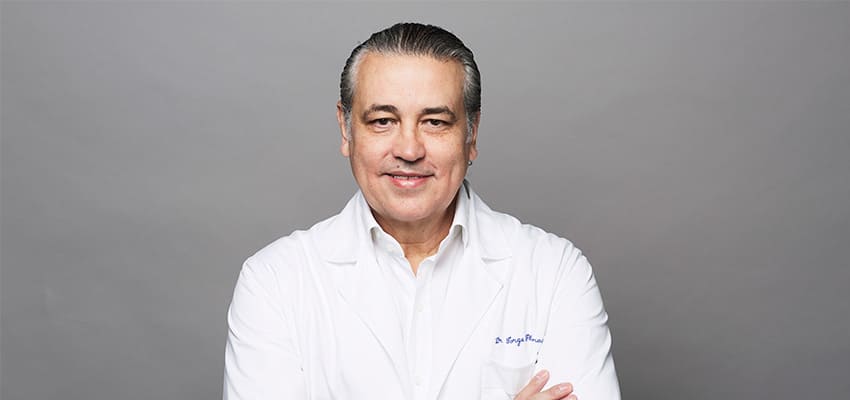
Entrevista: Dr. Jorge Planas
DR JORGE PLANAS: ‘YOU DON'T JUST CHANGE THE FACES OF PATIENTS, BUT IN MANY CASES YOU ALSO CHANGE THEIR LIVES’.
How would you describe yourself?
A passionate person. Everything I do in my life, I do with passion. I don't think it's something you can work on. Passion comes from enthusiasm, which arises from successes in life. It is very important in life to make the right decisions. Every day we make many decisions, from choosing what to wear to going to the cinema or staying at home. Most of these decisions are insignificant—they won't change your life or affect your happiness. Yet, some early-life decisions are highly consequential and demand careful consideration. It must be said: luck also plays a part. One of those decisions is the profession you choose. You can't go wrong there, because there's rarely any turning back.
Were you influenced by your father?
No, because my father always told us to pursue whatever we wanted. None of the three brothers forced us to become doctors simply because he built his own clinic. And that's because my father could have been my grandfather, because he married very late. As my father was almost fifty when he had me, he could have had a whole generation in between. On more than one occasion, he had told us that, after establishing the first plastic surgery clinic in Europe, he was very excited that someone was pursuing a career in medicine. But he never imposed it or even conditioned us so that two of the three brothers ended up dedicating ourselves to it.
How do you cope with the fame of such a renowned father?
At the age of 8, I went down to the operating theatre not because my father forced me to, but because we lived on the floor above the clinic itself. It's like the mechanic's son who has the workshop downstairs and watches his father repair motorbikes every day. So, I chose to do the same thing as my father, not only because I liked it, but also because I had been exposed to it since I was a child.
Has the student surpassed the teacher?
Surgery has changed significantly. I believe that not only my father, but all the professionals of that generation, in most medical specialities, deserve much more credit, because they invented the surgical techniques. For example, my father invented a breast reduction technique, another for abdominal lipectomy... And, in the middle of the last century, practically all aesthetic surgery techniques were invented. Techniques that did not exist before, that someone had to come up with: how to reduce a breast, how to lift the areola without killing it, how to reduce an abdomen without causing necrosis, how to remove fat from the hips so that it looks even, how to make a nose look uniform... All based on invention. Therefore, all the credit goes to that generation. I remember my father explaining to me the great fears they experienced when removing a bandage or plaster cast, because at first they did not know how it would turn out. Now, however, the techniques have been perfected to such an extent that I can remove a bandage with complete peace of mind and absolute certainty that the result will be as desired.
Would you like any of your children to continue the saga?
I have 3 children: Alexia (age: 21), Jaime (age: 17) and Mauro (age: 10). I must admit that I would like one of them to follow in my footsteps, because it is a very rewarding profession. Not only do I change my patients' faces, but I also change many of their lives. Furthermore, it is a profession that combines science, art, and psychology:
Science, because you must have training as a doctor and surgeon, and know surgical techniques and the fascinating world of human anatomy.
Art, because no matter how well you know surgical techniques, there is always a percentage that you contribute as an artist. It is not the same to leave the nose upturned or completely straight. It is like moulding a sculpture, like an artist sculpting marble, but working with other, more delicate materials.
Psychology, because we are treating patients who have a complex. These are people whose wishes must be understood very clearly, that they are correct and, above all, that they are not doing it for someone else or out of a moment of emotional desperation. In the latter case, the mood is lower and, sometimes, wrong decisions can be made to change any aspect of the body.
We were discussing your profession...
It never gets boring. It is a very flexible profession because you see new patients every time, you operate using different techniques, and each case is different from the next; for example, I have never encountered two noses that are the same. Dealing with patients leads you to plan each case for each individual. At 50 and 60 years of age, a surgeon still has the vigour of a young person with the experience and maturity of having performed many operations and handled numerous cases. Now, at 56, I find myself at the peak of my professional life. Even when you retire (at 70), you can transition to a phase of teaching, organising, and research. I would recommend this profession because you would lead a professional life full of very different stages.
Who sets the trends?
The most widespread audiovisual impacts: television, cinema and magazines, in that order. For example, during a training period in Brazil (1989), I realised that there were no cases of breast enlargement. The standard of beauty was a flat chest and well-contoured buttocks. Teenagers with a size 85 (bust, which here would be considered small) came to me to have it reduced because they looked like “cows” (the literal term they themselves used). Obviously, I ended up telling them that I couldn't operate on them, because it would leave one breast, which was already perfect, covered in scars. Ten years later, Brazil is the second country in the world with the highest number of breast implants. The only thing that has changed to be able to modify an entire pattern of beauty in a country is audiovisual impact. It is very difficult to make an entire country aware that what they see as beautiful today will not be so tomorrow, and vice versa. This change in mentality in Brazil only came about largely due to an audiovisual trend that came from North America with popular series such as Baywatch and models as exuberant as Pamela Anderson, with a considerably large bust size.
If we look back at history, from the Venus of Willendorf (Palaeolithic) to Marilyn Monroe, standards of physical beauty have been constantly changing, not only in different parts of the world, but also within the same region. Furthermore, it should be added that changes are happening at an increasingly rapid pace. During the Renaissance, Ancient Greece, or even the Egyptian civilisations, standards of beauty lasted for centuries; not like today. This acceleration in changing tastes is affecting the world of surgery. In the 1970s, for example, upturned noses were in fashion, and now straight noses are in fashion. In the 1960s, small breasts were in fashion, in the 1980s and 1990s, huge breasts were in fashion, and now the trend is towards normality. The same goes for the voluminous lips of a few years ago, because now people are looking for naturalness.
That is why I believe we should always remain normal. The best thing is for surgery to be unnoticeable, so that no one can tell that someone has had their lips operated on or that they are wearing a sign saying ‘I've had my nose done’. The best thing is for them to say how well this person looks and how well they take care of themselves. That is our goal.
Your favourite speciality?
Rhinoplasty. I like fixing noses, above all, because no two are alike. It is a type of surgery that is always demanding, because a millimetre can greatly change one's entire appearance. It is a very rewarding operation. There are also many noses that are untouchable. In fact, this is not the first time I have refused to operate on some of them. At the end of the day, everything has to be in proportion. The rule of proportion is fundamental. The rest of the body must be proportionate to that nose. If a person is tall with a triangular face and has prominent cheekbones and chin, you have to convince them that their large nose suits their face. Otherwise, even if we reduce the size of the nose and make it look natural, it will look disproportionate to the rest of the face.
When you are in a public place, outside Clínica Planas, do you notice other people's noses?
It often happens to me in lifts, because it's a place where you're very close to other people. Although I disconnect quite a bit from my profession when I leave the clinic, I observe other people's noses and even think about touching up some of them. But I would never say so, because you should never create a complex where none exists.
If it is a matter of removing a complex, should it not be treated by psychology?
When I was little, they called me “Dumbo”, but when I was 8, I had an operation on my ears and in class they went back to calling me Jorge. In my book CIRUGÍA ESTÉTICA SIN TRAMPA NI CARTÓN (Aesthetic Surgery Without Tricks or Gimmicks), I discuss surgery, which has made it possible to use something that did not exist before to solve a complex. I agree with Carmen Posadas when, in the foreword to my book, she writes that if Cyrano De Bergerac had had the opportunity to have surgery on his nose, he would have done so. He died without being able to sign his name on those romantic letters to his platonic love, because he believed he would always be rejected because of his nose. Whatever the problem may be, if it can be solved, the person will feel more comfortable and secure. It can even change people's character.
Is there a limit?
Yes. The plastic surgeon always has to put the brakes on when he sees that the patient wants to cross that line (both in terms of the number of procedures and in situations where the proportions are already correct in relation to the rest of the body).