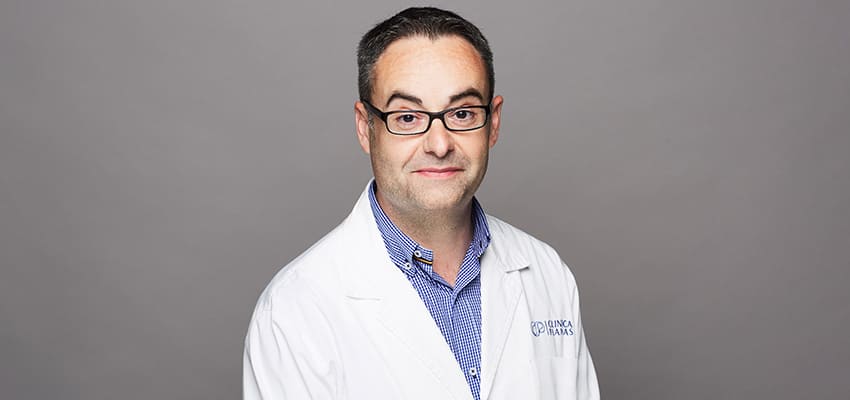
Entrevista: Dr. Jaume Masià
‘THERE IS AN ALMOST ADDICTIVE SATISFACTION IN SEEING THE EYES OF PATIENTS SHINE AFTER THEY’VE REGAINED THEIR QUALITY OF LIFE’
How would you describe yourself?
Passionate, restless. I am a vocational person who loves my work. ‘Passionate’ because of the passion I put into my work and my desire to learn to always achieve excellence. And ‘restless’, because of the curiosity that has motivated me to seek new challenges and new frontiers in the field of plastic surgery.
How do you manage to satisfy this ‘restlessness’?
This restlessness, the reason I was able to learn so easily, came to me during my university days. I realised that there was not just one way of looking at things. At the University of Barcelona, I was in contact with students from other universities who had different learning methodologies. This led me to travel to other centres in the United Kingdom, Belgium and Sweden, and to see that the same cases could be carried out using different techniques. The experience enriched me both in my university and professional life and in my human expertise. I learned tolerance and respect for my classmates, and above all, to share ideas with them. Even today, I enjoy learning about the techniques presented by foreign colleagues, and if they are worthwhile, I do not hesitate to get on a plane and meet them and their patients in person. It is a matter of breaking down the topic I am interested in studying.
- You’re so passionate that I don’t dare ask if you’ve ever imagined yourself doing something else.
I'll be honest. Before starting my university career, in the height of my immaturity, I was very fond of the artistic world with all the creativity of fashion, design and clothing.
Of course, coming from a small family of rice farmers in the Ebro Delta, my father wisely advised me to choose a more conventional career and, once I had completed it, if I still believed that fashion was my vocation, I would be young enough to embark on another path.
-You are not only a plastic surgeon, you are also head of the Microsurgery and Advanced Breast Reconstruction Unit at Clínica Planas, Director of the Plastic and Restorative Surgery Department at Santa Creu i Sant Pau Hospital in Barcelona, and recently appointed Chairman of the Spanish Society of Plastic, Restorative and Aesthetic Surgery (SECPRE). What led you to pursue a career in surgery?
When I started my medical degree, I began to learn about the different specialities. I was immediately drawn to the world of surgery, whether it was urology, gynaecology, or other surgical specialities that I studied during my undergraduate degree.
I was fortunate enough to come into contact with a plastic surgeon practising in Tarragona, Dr José María Pons, and assist him in his more creative work. I was fascinated by his skill with tissues, to the point of reconstructing a minor defect created after cancer. I was truly amazed.
My restlessness influenced my decision to go to a place where high-level plastic surgery was practised. I thus applied to the University of Oxford (United Kingdom) to enter Radcliffe Infirmary, a leading centre for plastic and craniofacial surgery in the English-speaking world. During those three months, I met Dr Michael Poole, who made me realise the healing, reconstructive and creative power of surgery, even when operating on children with craniofacial malformations, some of whom would not have been able to continue living otherwise. He was very compassionate, and I wanted to learn from his assiduous dedication and altruism in his work with people from less developed countries such as India and Pakistan. That was when I realised that I wanted to devote myself to restorative plastic surgery.
-After earning an Excellent rating as a Resident Medical Intern (MIR) at Santa Creu i Sant Pau Hospital in Barcelona, what path brought you to Clínica Planas?
During all my holidays over the five years of my Resident Medical Intern training, I went beyond simply learning the plastic surgery practised in Spain at the time, but I also travelled to different centres around the world (England, the US, Finland, etc.) every year to learn new techniques that pointed to the future. Perforator microsurgery was the most revolutionary development in the field of restorative surgery in the last two decades. It uses minimally invasive techniques capable of extensive patient reconstruction. I wanted to work in those foreign centres before finishing my residency. When I returned to Spain, I began performing this type of surgery on a few cases at Sant Pau Hospital in Barcelona. At the time, no one else was doing it, virtually no one knew about it, and very few people believed in it. I don't know if it was a matter of luck, but all the cases went very well.
While still a resident, I presented these initial results at the National Plastic Surgery Congress held in 2000. Professor Jaime Planas was in that room. We did not know each other personally, though I had attended some of the doctoral courses he taught. A month later, I received a call from Clínica Planas because Professor Jaime Planas wanted to meet me. My first impression of him was a friendly and good-natured person. We understood each other immediately. Despite his age, he struck me as a restless person, who always tried to keep up to date by reading about the latest advances in plastic surgery. He praised my short career in perforator microsurgery as excellent, especially considering how I performed those surgical techniques with my lack of experience and limited resources. Professor Planas agreed with my view that these techniques were the future, and for that reason, he wanted me at his clinic. I only set one condition: I wanted to continue working in the public health system and develop my career as a plastic surgeon. He didn't object at all, and I was able to juggle both. We agreed that, after a few months, if either party was unhappy, we would part ways and still be delighted to have met each other. And I'm still here.
What do you find most satisfying about reconstructive surgery?
It actually entails a double satisfaction. One is to see your work accomplished, your own vain and selfish creativity. It's about being able to say to yourself: I am capable of doing this complex task, it suits me well, and how satisfying it is to be able to do it when it is in the hands of only a few professionals. That is the pride of one's own vanity.
However, what is truly most rewarding, and here I mention the second source of satisfaction, is seeing how your work affects your patients, helping to cure a problem that seems incurable or, for example, restoring function to someone suffering from a complex tibia fracture so that they can walk again. We are able to restore self-esteem to someone who had lost their quality of life, feeling miserable or unfortunate because they were suffering from breast cancer. Being able to look into the glistening eyes of patients who have regained their quality of life is almost addictive.
Can you share any cases of satisfaction?
When it comes to breast reconstruction, after removing the cancer, we tend to forget what the breast means for a woman's body symmetry. The lack of self-esteem after a mastectomy may distance a woman from the everyday world around her. It limits everyday, simple yet necessary activities such as trying on clothes in a shop, going to the gym for fear of people seeing you without a chest, or feeling self-conscious when hugging your partner.
Let me explain the case of a woman in her sixties who came into my office with her daughter fifteen years after having a mastectomy to see what could be done. The patient was resigned to living without a breast after so long. Her daughter, a nurse, encouraged her to undergo breast reconstruction. After the implant, she was delighted to regain the everyday routine of a normal life. But she was even more excited because, for the first time, she could hug her five-year-old grandson without fear of him accidentally touching her cleavage and realising she had an external plastic prosthesis. The fear that her grandson might see that she didn’t have a breast and was wearing “something” prevented her from hugging him with all the fervour and warmth that a grandmother normally does. This was the most comforting thing for her.
What is the artistry in your speciality?
Plastic surgery is a poorly regulated field of surgery with no fixed standards. Therefore, it requires a degree of creativity to achieve excellent functional, aesthetic and cosmetic results. The same creativity we use in combining tissues is what sculptors use when they mould clay. So rather than artistry, I would prefer to draw a parallel with creativity.
And who determines this ‘creativity’ that you mention?
Let us begin by making it clear that plastic surgeons do not have a magic wand. Unfortunately, we are subject to the pressure of a series of advertising concepts.
What can be appealing about a woman's figure, with a series of pronounced curves, is that physiologically it represents a healthy woman. And what may be appealing about a man's broad back and chest is what it represents in the context of animal behaviour, that is, a healthy, strong male who thousands of years ago went out hunting and returned with prey to ensure food for his family.
Cinema and other media exaggerate these concepts to make the information they convey more appealing, so that without realising it, we are exaggerating and taking our tendencies and tastes to extremes. Society, without meaning to, demands what it sees or what, unwittingly, is being offered to it.
Is this an advantage for you or, on the contrary, pressure to deliver the results that a patient expects?
It is an advantage to be able to tell a patient that we can improve their condition or solve their problem. But first we must pause and consider whether what the patient is asking for is consistent with his or her appearance. A surgeon able to convey this to the patient will gain his or her trust and thus do what is best for the patient. In short, we improve that ‘doctor-patient’ relationship that we must never lose, as it is the cornerstone of any medical act, without compromising professional ethics or medical advice.
You use microsurgery in breast reconstruction with tissue from the patient's own body; fat and tissue from the abdomen (DIEP - Deep Inferior Epigastric Perforator) or buttocks (SGAP - Superior Gluteal Artery Perforator) are transferred to the chest and moulded into the shape of the breast in a single surgical operation, offering a completely natural result. What does it mean to you to be a pioneer in Spain of this highly complex technique?
No one is a prophet in their own land, which is why I am so grateful to Professor Jaime Planas. He believed in ‘someone’ who had no background, who was just starting out and whose only asset was enthusiasm in a very new field, which even part of the scientific community did not believe in. This trust and generosity have been the cornerstones of my relationship with Clínica Planas. Being a pioneer in this technique means two things: first, the pride of doing something that people are unfamiliar with, and second, a terrible fear that if I make a mistake, everyone will stop believing in me and no one will support me. It is a ‘positive-negative’ stimulus that pushes me to surpass myself more and more. A pride that turns into satisfaction when things turned out as I had believed they would from the very beginning. Some people stand out because of some advertising strategy and others, such as Professor Jaime Planas, pioneers and innovators who stand out for their solid track record, their generosity in sharing knowledge and the opportunities they give to projects that are valid and innovative.
Professor Jaime Planas gave you the opportunity to develop your project at Clínica Planas, but did he give you any guidance when you joined?
It was a difficult time for me. Much of the scientific community in this country questioned the viability of my surgery, both because of my immaturity and because of the novelty of the technique I was applying. In terms of guidance, Professor Jaime Planas taught me to work hard, helping those in need and sharing my experience without worrying about what gossipmongers might say. And so I did, like those of us who work here, sharing the knowledge we acquire, treating my patients well and advancing in the new techniques of the speciality without letting criticism affect me.
I just had to wait because time always brings the truth to light. Some ‘old glories’ publicly claimed that I was performing experimental surgery on my patients. That was not true, because the techniques I used in my early days were internationally recognised, a fact that perhaps those who criticised them were unaware of. Professor Planas was right, and now those who questioned me are great advocates of my views and acknowledge this.
Who has given you the best advice?
I have received a great deal of good advice. At every stage of my life, I have had someone who has had a profound impact on me:
In my pre-university family environment, I was taught to strive to better myself. I remember my grandmother, a simple country woman, who taught me the fundamentals of dignity, honour and loyalty to what you believe in and to those who believe in you.
In medical school, I remember a general surgeon, Dr Roger Pla, who was able to convey to me the rigour of a job well done and respect for the surgeon who is teaching you, to the point that if he does not eat, you do not eat, and if the surgeon does not get tired, you should not get tired either.
During my specialisation, I learnt to listen to everyone, even the most ignorant. I came across highly respected professionals who not only listened to their knowledgeable colleagues, but also listened to students who asked seemingly absurd questions, which perhaps were not so absurd after all. Curious questions open up unknown fields for learning.
When I began my career as a plastic surgeon, I recall Professor Jaime Planas and Doctor Pedro Serret from Sant Pau Hospital, and their valuable advice on patient care; knowing how to be there for them in both good times and bad. Then they give you heartfelt thanks when they say, ‘Doctor, thank you for always being by my side and experiencing these complications with me as if you were feeling them in your own flesh’.
Now you are the teacher. You teach at the Autonomous University of Barcelona and master's degrees at René Descartes University in Paris (France) and Helsinki Central University (Finland). How do you pass on your advice to the younger generations?
I consider myself somewhat revolutionary, even in the way I teach. I do not want my students to take notes as if they were secretaries or to memorise absurd lists. I try to move away from the typical lecture format so that students acquire the methodology and reasoning skills needed to search for information about the case presented to them and thus find the solution. The approach of my classes is as follows: students learn to analyse the problem, seek out the source of knowledge and apply it to the complication.
Your work ‘Después del cáncer de mama’ (After Breast Cancer) is an informative book that offers clear and concise information on how to cope with breast cancer and how to regain quality of life once the disease has been overcome. What was your aim in writing it?
Through my contact with patients and mastectomy patient associations, I realised how widespread misinformation was on the subject, perhaps even due to doctors who perpetuate overly biased information. That is why I wrote ‘After Breast Cancer’ with clear, simple information explaining all the pros and cons and expectations of all breast reconstruction techniques and, above all, including real testimonials from patients who described their experience from start to finish; from facing a breast cancer diagnosis to full recovery after completing comprehensive treatment with reconstruction.
Can information overload misinform?
The internet offers such a wealth of information that we sometimes get lost. Whether it is because it is at a very high or very low level, we can also find poorly verified information without any filtering. You ‘surf’ with so much information that the ‘waves’ of knowledge swallow you up.
On the other hand, our speciality is very broad, and in order to obtain adequate and accurate information, it is necessary to find a professional who is well trained in a specific field. There is no such thing as a super surgeon who can do everything well. That is why, within each speciality, we are becoming ‘hyper-specialised’.
Over 90% of women survive breast cancer, but only 15% decide to have their breasts reconstructed after a mastectomy. What motivates a mastectomy patient to have breast reconstruction?
The desire and right to improve quality of life after overcoming breast cancer. Despite the excellent prognosis for this terrible disease, the after-effects of the treatment itself are considerable. The most well-known is breast loss (amastia), but other equally debilitating conditions such as lymphedema continue to affect almost a third of patients undergoing treatment for breast cancer. The first major step in making a decision about reconstruction is the availability of clear, simple, and concise information. Many women who have had a mastectomy are unaware of how much breast reconstruction can improve their quality of life. The book ‘After Breast Cancer’ helps fill the gap between overcoming cancer and improving quality of life. When patients are well informed, 80% undergo reconstruction.
What is the best and worst thing about your speciality?
The best part is the creative aspect. It never becomes routine, either because of the technical aspects of the surgery or because of what it means to people. Two levels of feedback that fascinate specialists. I could consider it a way of life, and that's the problem. That's why the worst thing is that it's such an exciting, addictive and time-consuming speciality that you can end up taking that time away from the people you love most, your family. Operations are lengthy, and if they are complicated, they can take even longer. Being at the forefront of global knowledge requires constantly travelling to different conferences, not only to keep up to date, but also to share new ideas. So you end up stealing time away from your family, because even when you're at home having dinner with your children, you're worried about the patients you've just operated on and you know they could call you at any moment. That is why it is so important to be in a supportive environment with people who understand what this work means to you.
What sort of patient schedules an appointment with Dr Jaume Masiá?
Every possible kind of woman. Breast cancer does not discriminate based on social class, education or age (between 20 and 75 years old). There is a growing demand for reconstructive surgery. Normally, she is a woman who wants to do it for herself, and depending on her emotional environment, she may be accompanied by her partner, children, parents or friends. There is no longer any fear of explaining it; sharing it helps to overcome cancer with greater strength. The patients who generously shared their testimonies in ‘After Breast Cancer’ know that by explaining their experiences, they are helping many people. These human stories shared by every patient are still with me, and they give me the energy I need to contribute something more than just surgical technique to the speciality.
The photograph that Professor Jaime Planas gave you to mark the 30th anniversary of Clínica Planas contains the following words dated 7 October 2001: ‘To the doctor, colleague and friend, with my affection and consideration’. You had only been in the clinic for a year. What was your relationship like?
I was not a disciple under his tutelage because Professor Jaime Planas had already retired when I joined Clínica Planas. But I was able to share many beautiful moments with him over five years. He was passionate about reconstructive surgery and, every afternoon, when he left the clinic library, he would come to my office to discuss some articles from medical journals and consult me about the new developments we were implementing at Sant Pau Hospital. He was concerned about some of the cases I was handling and even went down to the operating theatre with his camera to photograph surgeries he had never performed. Throughout that hour we spent together, Professor Planas compared those current photographs with others he had taken in the 1950s, for example, to treat similar cases with different approaches. That relationship, rather than one of teacher and pupil, was almost one of friendship, with a significant generational difference, but with the same concerns.
On the walls of his office hang three numbered lithographs of female nudes by Edgar Degas, Claude Monet, and Adrianus Johannes van't Hoff. Is it significant that all three are Impressionists?
I love how Impressionist artists depict the female nude so naturally. The Impressionists know how to realistically reflect the beauty of the nude woman in everyday situations. I am in love with painting and female photography. I have hundreds of books on this subject at home. I often travel to Paris for work, and whenever I can, I visit exhibitions on nudes and women. My wife says I'm obsessed, but I consider myself to be in love with the female body. I am fortunate to work with him and help improve it in the case of aesthetic surgery or reconstruct it when that body is altered by breast cancer.
One of Clínica Planas' latest expansions is the renovated Breast Unit, of which you are an important part. What were the reasons behind dedicating this expansion to breast health?
If we want to perform excellent surgery in all areas of breast surgery and we have an excellent team of breast specialists and plastic surgeons, why not complete this ambitious project with a comprehensive breast cancer unit that brings together leaders and experts in all fields in a single centre, interacting in a fully coordinated manner?
What will this expanded Breast Unit offer patients?
At Clínica Planas, we have the knowledge, experience and technological resources to offer a service that no one else in this country offers in the private healthcare sector. This Breast Unit provides patients with security and assurance from the initial examination of the tumour until the entire process is complete. Professional excellence accompanies the patient at all times with a fully integrated, consolidated and optimised team so that all tests and the synchronisation of elements are carried out immediately, without wasting time and, above all, without losing the human touch that patients might lose when forced to ‘jump’ from centre to centre, from office to office, from test to test, without having someone to guide and coordinate the entire process.
Where is plastic surgery heading?
The speciality focuses on achieving highly specific reconstructions with optimal tissue, functional reconstructions, and reconstructions with cosmetic and aesthetic excellence. The future lies in restoring 100% normality with less aggressive treatments that could result in zero functional loss. In addition, surgical techniques will be combined with tissue regeneration techniques, which will allow us to reconstruct tissue that is specific to each case in the future, in an almost preoperative manner through tissue engineering.
At 42 years of age, you have recently been appointed Chairman of the Spanish Society of Plastic, Restorative and Aesthetic Surgery (SECPRE). How did you reach this role?
Honestly, I don't know. However, a good number of fellow SECPRE members from different parts of Spain convinced me to put myself forward as a candidate. Fortunately, she was the one who won the election for the current chair. Perhaps they wanted a different profile for the chair of plastic surgery, and this restless and enthusiastic nature of mine, which has brought me to where I am today, could be the reason.
I have been SECPRE chair since 1 January 2011, and before proposing any significant changes, I would like to analyse and gather the concerns of the different members of the society. Our intention is to raise awareness and position Spanish plastic and aesthetic surgery internationally as representing the highest standards. This effort should also serve to provide SECPRE with a set of tools to help members achieve their training goals and promote research in the various fields of plastic and aesthetic surgery. SECPRE also aims to be increasingly closer to the population, to guide patients in possible treatments and, of course, to avoid complications.
Let’s finish our interview with our customary final question: who or what would you put under the scalpel?
The ones who legislate and implement health policy, who only focus on economic criteria and certain electoral strategies, and who sometimes fail to address the real, underlying problems of the population. Healthcare is an essential right that should be universal. Currently, in the context of economic recession, there is a risk of cutting healthcare resources when, perhaps, we should be improving management in other areas that are less essential to the lives of our people.