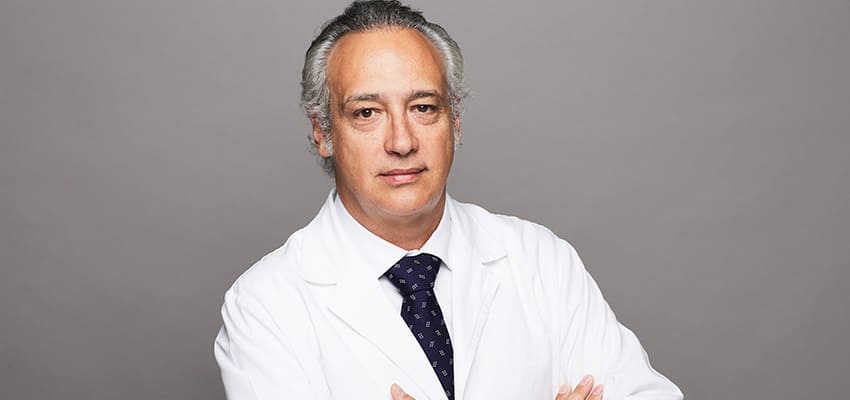
Entrevista: Dr. Gabriel Planas
DR GABRIEL PLANAS: ‘THE GREAT REVOLUTION IN PLASTIC SURGERY LIES IN STEM CELL RESEARCH, WHICH WILL RENDER MANY OF THE PROCEDURES PERFORMED TODAY UNNECESSARY.’
Was there ever a time you thought about studying something other than plastic surgery, or was following the family tradition always the plan?
No other career appealed to me more. It's also something I was familiar with growing up. I always saw my father as very happy in this profession.
Dr Jaime Planas was a discreet, generous and very humane person, a quality that made his patients love him. Your colleagues say that you share many qualities with your father, such as your personal connection with patients. What sort of guidance did your father, Dr Jaime Planas, offer you?
I keep his advice on display in my office. For example, I have a paperweight engraved with one of his core sayings: ‘use your knowledge generously and humanely’. But the most famous of his sayings, and the one I remember most, is: ‘Do not fear competition – referring to other surgeons – but rather incompetence.’ He emphasised that if one colleague had poor results, it would damage the reputation of the entire profession. In addition, my father used to tell us that you should teach everything you know and never rejoice in the failures of others, which, in reality, will also be your own. And I believe that applies to all professions. Dr Jaime Planas was the founder of the principles of the clinic and the heart and soul of Clínica Planas. The core principles are straightforward: never attempt a procedure you haven't mastered, commit to thorough training, and critically, learn to say no—a skill that is often the hardest to apply...
‘Knowing how to say no’?
You have to know how to say no, because there are patients who insist on having surgery, with unrealistic expectations or as a means of solving personal problems – often to win back their partner – or because they suffer from body dysmorphic disorder (an unrealistic perception of their own body). If you agree to operate on them, it will be a failure. These issues are dealt with by psychology.
Therefore, we ultimately refer the patient to our psychologist, Dr Elena Bisbal. She ultimately determines whether or not the intervention is warranted.
Recently, I performed minor liposuction on a person who had suffered from anorexia—strange as it may seem—because their psychiatrist advised me to do so. The patient was very obsessed with that particular area – her knees. And, although she was really very thin compared to the rest of her body, if we removed the fat from that area, the result, she assured me, would be satisfactory. In any case, the vast majority of patients who come to Clínica Planas have realistic expectations and the operation they request is indicated.
We were talking about your father. Dr Jaime Planas' principles are very much in evidence at Clínica Planas. When a new specialist arrives, how is this work philosophy conveyed to them?
Traditionally, they were trained by him. In fact, all the surgeons at the clinic were his students: Dr Javier Bisbal, Dr Carlos del Cacho, Dr Arturo Carbonell, my brother Dr Jorge Planas, and myself. Dr Jaume Masiá, a specialist in microsurgery, is the only one not trained by my father, but he is very familiar with his philosophy.
Your father's dream was to have a centre where he could teach. We know that you are continuing the work of the Jaime Planas Foundation. What does this project you are collaborating on consist of?
One of the Professor's obsessions was, in fact, teaching. In fact, that was one of the main reasons why he built Clínica Planas. From the outset, it was used as a venue for courses and conferences on the subject; initially in the waiting room, then in marquees and, following the extension of the clinic, in an auditorium with capacity for 550 attendees and equipped with all the necessary technology – live broadcasts from the operating theatre, simultaneous translation, etc. He was concerned that this aspect should be perpetuated and, to this end, he created the Jaime Planas Foundation, to which he contributed his plastic surgery library, one of the best in the world in this field, as well as a legacy to ensure its continuity.
We also offer scholarships for residents, who live and train at the clinic for periods of six months to a year. They are surgeons who have completed their specialisation in their own countries and wish to expand their knowledge, particularly in aesthetic surgery. At Clínica Planas, they are provided with accommodation and meals. There are usually about five residents from all over the world, mainly from Latin America, Brazil and Italy.
In addition to the monographic courses we offer throughout the year, we have the International Course in Plastic and Aesthetic Surgery—the next one will take place on 7–10 May 2008—within which we have created the Jaime Planas Master Class. The first presentation will feature Professor Fernando Ortiz-Monasterio from Mexico, and the next will feature Professor Ricardo Baroudi from Brazil, both of whom are internationally renowned.
The Jaime Planas Foundation also collaborates on a project run by the non-governmental organisation AMREF (African Medical and Research Foundation), sending surgeons to East Africa to perform plastic surgery on people without financial resources.
Once a year, the Flying Doctors project lands in sub-Saharan Africa to operate in tents and prefabricated hospitals, mainly on congenital malformations and burn sequelae.
This must be very rewarding for a doctor, as it is the underlying philosophy behind why you studied medicine, right?
Yes, it is incredible to see the queues of patients waiting to be seen and that, even though they are operating day and night, many have to wait until the following year to have their operation. The scarcity of resources is tremendous. So we also try to train local surgeons.
Dr Asrat Mengiste, project coordinator in Kenya, told me that there are more Ethiopian plastic surgeons – emigrants – working in the United States than in Ethiopia itself.
Plastic surgery has advanced greatly in a short period of time. Has it reached its limit, or is its revolution yet to come?
We must invest more in stem cell research. Surgery has its limits, and little progress can be made with a scalpel. The great revolution in plastic surgery lies in stem cell research, which will render many of the procedures performed today unnecessary.
What is the current trend? What are your patients asking for most?
Discretion. The result should be natural-looking, without any signs of having had surgery. The ostentation of aesthetic surgery might be very popular in the United States, but it has never caught on in Europe. Here, we appreciate natural beauty.
What are the benchmarks that patients look to?
There are anecdotal cases of patients who bring in photos of breasts featured in all kinds of fashion magazines, including erotic ones. They also bring up famous people. A recent case involved a patient who came into my office saying she wanted to look like Nieves Álvarez.
There is no doubt that trends are set by the media, especially television series, fashion, the star system... Young girls are more vulnerable to falling into this trap; to being influenced by the appearance of models, actresses, singers... On the other hand, a more mature person already has a very clear idea of what they want.
Your brother Jorge told us in the previous issue that he had surgery on his ears because they called him ‘Dumbo’ at school, have you ever ‘gotten rid’ of a complex?
Not yet. I suppose I will go ahead with the hair transplant, as Dr Llorens' results are very natural. But for now, I'm holding out...
Are men still reluctant, or is that now a thing of the past?
More and more operations are being performed, but it should also be noted that we have fewer things to operate on compared to women. More than 50% of the surgery performed at Clínica Planas is breast augmentation or reduction – one less thing that men have to undergo surgery for. Liposuction is performed, but not in as many areas as those where women accumulate fat – the hips, for example – and other procedures – such as areas that are damaged during pregnancy.
What is your favourite speciality?
Although I also like other types of surgery, such as facial surgery, my favourite is breast surgery – augmentation, reduction, lift...
‘Favourite’, why? Because of the way you work? Because of the results you achieve? Because of patient satisfaction?
A bit of everything. One of the pieces of advice I heard during my residency was that ‘patients will shape your career’. Those who are satisfied with your work will send you more patients so that you can do the same for them. And conversely, what you are not so good at, you will do less often. It is the patients themselves who shape your practice. It ultimately comes down to ‘word of mouth’.
What is the best and worst thing about your profession?
The best thing is patient satisfaction. When they are discharged and we take photos showing the ‘before and after’, they have often forgotten what they looked like before the operation. In fact, they no longer want anything to do with their old image – some even ask me to delete it from my computer.
What I dislike most is when you cannot solve a patient's problem or when they are not satisfied with the result, which also happens.
When Dr Gabriel Planas finishes his workday as a doctor and leaves Clínica Planas, does the practice continue?
No, but if you're in a waiting room or on a plane, you can't help but entertain yourself by ‘operating’ on the other passengers.
Finally, who or what would you change the face of?
The face of the world, of the planet.
Would you put it under the scalpel?
I mean that we should learn to use the scalpel less, both literally and figuratively, by practicing restraint in consumption, driving, and flying, prioritising our community more. Just as we only have one body, we must protect our single planet by consuming locally and strengthening our human connections.