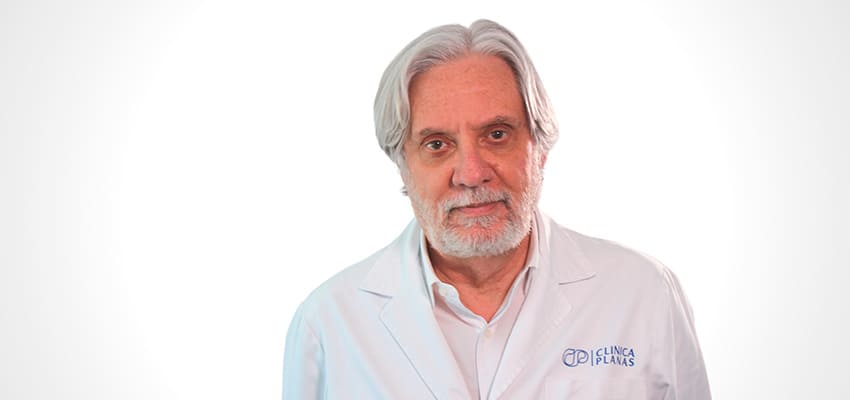
Entrevista: Dr. Carlos del Cacho
‘LEVERAGING AN OBSERVATION FROM THE LEAST EXPERIENCED INTERNIST IS A SIGN OF INTELLIGENCE, NOT JUST HUMILITY’
Our prior conversations with doctors at Clínica Planas have taught us that their professional practice emphasises a close relationship with patients. So who are you, Carlos or Dr del Cacho?
First and foremost, I am Dr del Cacho, but when I am with a patient, I am Carlos. That's how it's always been during the 28 years I've been working here. I consider myself very meticulous and I try to be very considerate to my patients, whatever the day or time. Being considerate and available when they need me are what they value most. They know that I am always there when they need me.
You are a specialist in Restorative and Aesthetic Plastic Surgery and Chairman of the Catalan Society of Restorative and Aesthetic Plastic Surgery. What got you get started on this career path?
From the outset, I was very clear that I wanted to be a surgeon. In my fourth year of medical school, I was doing surgical rotations when chance led me to discover plastic surgery. It is a surgical speciality that has a number of branches, including cosmetic surgery. At first, I was preparing for general surgery, which at that time basically meant becoming a digestive surgeon, but at a certain point, after much deliberation, even existential deliberation I would dare say, I decided on plastic surgery. When I finished my degree, I did my MIR (Resident Medical Intern) with a residency in the Plastic Surgery and Burns Department at Vall d'Hebrón Hospital in Barcelona, which, incidentally, is a very prestigious department in Spain. And when I finished my specialisation, I started working at Clínica Planas, where I perform a lot of body contouring and breast surgery.
You mentioned ‘chance’... Did it change your destiny?
I was given an opportunity to attend plastic surgery shifts when I was doing general surgery shifts. I juggled it, attended a few, liked it, and that's when I realised that it was another world where I felt much more at ease. At that time, I was an internist at the Clinical Hospital in a surgery ward, and I moved to the plastic surgery department of the same ward, where I focused all my training on this speciality.
Over three decades ago, plastic surgery presented numerous avenues for discovery. Did this potential for exploration draw you into the profession?
Certainly, there were many things to discover, but what captivated me most was the imaginative aspect of the specialty, which general surgery lacked. Plastic surgery appealed to me mainly because it was very creative and I felt that I enjoyed this type of surgery more than any other.
Other doctors have even drawn parallels between this speciality and art.
If art is creativity, which clearly involves a great deal of creativity, then yes, there is a parallel. When you are creating within certain beauty standards—which, although they may change, do exist—we are talking about an artistic speciality.
Who sets these beauty standards, the patient or you?
Patients are not always clear about these standards. However, they clearly see the challenge these standards pose and look to us for solutions. The doctor then steps in as a technician, bringing possible solutions within certain limits so that the patient can choose from among the indications for the disorder or problem they have. I say ‘technician’ because, obviously, a painter also needs technique to paint a picture; otherwise, he would be unable to mix oils or prepare a canvas.
You did an internship in Brazil with Dr Ricardo Baroudi (in Campinas) and Dr Antonio Bozola (in São José do Rio Preto). What did you learn?
First and foremost, it is always beneficial to move away from familiar territory and observe how others work in different environments. In Campinas, I learnt body contouring techniques, and in São José do Rio Preto, I learnt breast techniques. There I learnt some details that I was able to add to the knowledge passed on to me by my mentor, Dr Jaime Planas, founder of Clínica Planas. Now that techniques have become more interconnected across the globe, instead of travelling to see how they work in other countries, I attend conferences.
You called Dr Jaime Planas your ‘mentor’. Was he the one who gave you the best advice?
Not the ‘best advice’, but the ‘best overall advice’. Dr Jaime Planas gave me a path to follow, which I have tried to follow ever since. Almost everything I learnt from him, he didn't have to tell me because I saw it in him. Perhaps that is the most important thing, because when advice is given, sometimes the person giving it does not follow it; and such advice is merely performative. The advice, or rather, the attitude that one learns by observing the person's actions is very valuable because it is authentic. I was fortunate enough to learn how Professor Jaime Planas treated his patients, and I can assure you that many times—not only as a surgeon but also as a person—I think of my mentor when faced with any difficult situation and imagine how he would approach it.
Tell me something about Professor Jaime Planas's approach that still applies today.
Being very attentive to the patient and knowing that when there is a complication—and there are always complications, as in any job—that is when you have to be most attentive to the patient. We know that complications are unpleasant for everyone. When something goes wrong, sometimes you just want it to go away and never see that person again. This happens in all professions. It’s really no different here, yet you have to do the exact opposite. In this regard, you must have ethics, a strong resolve, and be more attentive to the patient than ever before. It’s really nice when a patient shows some appreciation with a gift when everything is easy sledding. The real reward, however, comes when you effectively manage and overcome complications. Dr Jaime Planas always held that a good doctor’s best reward is when medical complications yield positive outcomes’. In addition to such invaluable advice, he also gave us gifts with meaning behind them, such as a chess set, which represents how we are a family at Clínica Planas, and we all have to play together. In fact, I consider Dr Jaime Planas my scientific father, and in many ways I look to him as a role model, not only in the medical field, but also as a human being.
You have been teaching for over 20 years. Apart from teaching, do you also learn from your students?
You always learn from new students, because above all else in life, you have to learn to listen. Even the simplest person can always teach you something. It is not a question of humility, but of intelligence to take advantage of a comment made by the most junior resident doctor.
What do you expect your students to contribute to the specialisation?
I believe that what we have all contributed when we are young is enthusiasm. Enthusiasm is what drives the development of new techniques. Enthusiasm makes the speciality better known and respected through rigorous work.
Considering your significant educational background and passion for reading, how exactly does Dr del Cacho get ready for a class or lecture?
I am fortunate that God has given me and my children the gift of being able to express ourselves well. Perhaps my love for books plays a role, but I don't struggle with public speaking or feel anxious before a crowd, which is a beneficial trait. I am also a very meticulous person when I have to prepare something, and I try to do it very well. People who improvise make a lot of mistakes. There is no better improvisation than perfect preparation. I am one of those people who reviews and reviews again, and even in the car I repeat the lecture. The older I get, the more meticulous I become. When I began working with Professor Jaime Planas, I remember watching how he carried out an operation, and I wished I was already older, convinced that this would spare me the initial hardships I faced as a new surgeon. It turns out I was wrong. Things get harder as you gain more experience, because the more experience you have, the more you realise that so many things can go wrong. Returning to the parallel with the artist, this also happens to the true, mature artist, who, when it is time to go on stage, has more stage fright than when he was starting out.
Recently, Clínica Planas has been in the news for its use of stem cells extracted from fat removed during liposuction procedures. You have been part of this research team. Can you explain how you got to this point?
We cannot really specify their future applications, because they haven’t been developed yet, but we are convinced that they will be extraordinary. Stem cell-based regenerative medicine holds the key to the future of healthcare. One of the major problems is the source of these stem cells. We all know that umbilical cord cells are a source. But if we get rid of it when we are born, we have to look for stem cells in other sources. We are now fortunate that the laboratory has revealed that adipose tissue is rich in stem cells. During liposuction, these cells are isolated and stored in a bank. While there is currently no specific application for them, this is expected to change soon, especially for degenerative diseases, etc.
You've seen significant shifts in aesthetic surgery procedures. Looking ahead, what key innovations or changes do you foresee shaping the future of the industry?
I'm incredibly optimistic about the future of regenerative medicine, particularly our ability to grow new tissue using a patient's own cells, which would completely eliminate the risk of rejection. Imagine a day when breast augmentation means cultivating a woman's own mammary tissue from banked cells. This would be a remarkable, natural alternative to traditional silicone implants for breast enlargement. While the potential for complications is already low, fitting an implant grown from the patient’s own tissue would present fewer complications since it would originate from a natural, non-foreign source.
Fashion trends have spurred an increase in cosmetic surgery. Is this development positive, or does it heighten expectations for perfect results?
An advantage for the development of the speciality. A rise in demand naturally prompts additional research efforts, a growth in practical knowledge, and an enhancement in the specialised services we can deliver to society as a whole. However, this undeniably presents a challenge, as patients frequently offer opinions lacking proper knowledge or make demands based on misapprehensions. There's a vast amount of data online, but many people lack the background knowledge needed to accurately interpret the information, leading to confusion and misunderstanding. It would be comparable to me picking up a book on aerospace engineering and then offering my thoughts on it.
What have they asked you for?
I still remember a patient who asked me for a rhinoplasty the day before she was going to attend a wedding. She was an American girl with whom we already had scheduled an appointment on a Friday. I told her she would have to stay in hospital for at least a day because of the splint, the plugs. She insisted that she wanted to leave the same day after the operation. I did not recommend it. The patient was admitted. At this point, I still did not know why she insisted on leaving immediately. Finally, she told me she had to go to a wedding. I told her that she would not be able to attend, as she would not only have swollen eyes, but she would also be dealing with other post-operative effects. She ended up confessing that it was her own wedding. Needless to say, the operation was not performed, at least not here at Clínica Planas.
Have you ever had cosmetic surgery?
I haven't had surgery yet, but I'm convinced that one day I may have to have it done to remove the bags under my eyes that are starting to show. Considering the great success of blepharoplasty, I would not mind having the procedure done.
And finally, what or who would you change the face of?
The honesty of the people. The basis for a society to function is that people are honest with themselves first and then with those around them. Perhaps the global economic crisis we are currently experiencing is, among other things, a consequence of dishonesty.